Friday, March 17, 2017

COCOA KICKSTART


COCOA KICKSTART


Let’s be serious…many of us need a serious kick in the pants in the morning to get our day started properly. Most of us reach for our coffee to get things moving, but others are looking for something a bit healthier that can do the same thing. You have met your match.
Purpose
It’s time to enjoy a beverage that doesn’t leave us feeling the opposite of how we should within a few hours. This hot concoction delivers a serious boost to your metabolism, circulation, and immune system while providing a nice array of trace minerals for optimal healing. Not only that, it’s a serious blend of spice and bliss in a cup.
Don’t miss out on this hot elixir.
Equipment Required
  • A good quality blender
Ingredients
  • 3 tablespoons of Cacao
  • 1 teaspoon of Maca
  • 1/2 teaspoon of ground medicinal mushroom (or one drop of this tincture)
  • 1/2 teaspoon of Cinnamon
  • 6 large pitted dates (or your choice of natural sweetener)
  • 4 oz of Sprouted Almond Milk
  • 12 oz of hot water
  • 1/8 teaspoon of cayenne pepper
Directions
  • Combine all ingredients in blender and blend until smooth.
Consumption
    • Drink first thing in the morning, or whenever you require a delicious pick me up.

This Ancient Remedy “Cures All Diseases” HIV, AIDS, Diabetes, Cancer, Stroke, STDs, Arthritis & More


This Ancient Remedy “Cures All Diseases” HIV, AIDS, Diabetes, Cancer, Stroke, STDs, Arthritis & More …


The black seed plant (Nigella Sativa) is indigenous to the south and southwest Asia. For hundreds of years, this plant has been used for medicinal purposes by both Muslims and non-Muslims. Black cumin was first mentioned in the book of Isaiah, within the Old Testament, where Isaiah speaks of harvesting the black seed. But, it was not until the rise of Islam, when this plant really came into prominence.
  • A Cure For Many Things
In the Arab-Islamic culture, the black seeds were widely used for the treatment of numerous health problems, including asthma, fever, back pain, and chronic headaches.
These amazing seeds are a fantastic source of proteins, fatty acids, and many essential vitamins and minerals. Some studies conducted in recent years have shown that black cumin seeds possess potent anti-diabetic and anti-cancer properties. In addition to this, they can also help regulate the immune system, destroy harmful microorganisms, and even open the tiny air passages in the lungs. The pretty high antioxidant content of black seed oil helps protect the liver and the kidneys.
The following paragraphs offer useful information from recent studies in which it was thoroughly investigated how to use black cumin seed oil for reducing weight and inflammation, balancing blood chemistry, supporting healthy immune system functioning, and alleviating nasal dryness and discomfort.
  • Black Cumin Seeds are Highly Ranked as a Powerful Herbal Medicine
One recent study has shown that the active ingredients of black seed oil, such as thymoquinone, have very potent anti-inflammatory effects on several models of inflammation. These include: encephalomyelitis (inflammation of the brain and spinal cord after infection), edema (the swelling of soft tissues which occurs as a result of excess fluid accumulation), colitis (inflammation of the colon), peritonitis (inflammation of the membrane which lines the inside of the abdomen and all of the internal organs), and arthritis.
Also, the active ingredients in black seed oil were found to help regulate the immune system. Moreover, it was also discovered that they have strong antibacterial, antifungal, and even anti-tumor properties.
  • Black Seed are Useful for Treating Obesity!
People who are overweight are at much higher risk of cardiovascular disease, insulin resistance, immune dysfunction, and all types of cancers. For that reason, it is of utmost importance that obesity-mitigation strategies are also focused on these secondary pathologies in addition to promoting weight loss.
Luckily for us, we have black cumin to help us deal with all these issues. Its antioxidant, anti-diabetic, cardio-protective, immune-modulatory, and anti-cancer properties can help us to get rid of excess weight while significantly reducing the risk of the aforementioned health problems.
A great example of the healing effects of black seeds is one Iranian study in which the researchers examined the effects of long-term Nigella sativa supplementation, as well as the use of aerobic training on the lipid profile and oxygen consumption of sedentary overweight women.
This was a randomized double-blind controlled trial, in which 20 sedentary overweight women were divided into two groups and assigned to black seed supplementation or a placebo for the 8 weeks of the study. Both groups also had 3 aerobic training sessions per week. Blood lipids and VO2 max were determined before the start of the trial and at the end of 8 weeks. To understand better, it is important to know that VO2 max is a measurement of the maximum amount of oxygen that a person can use during exercising (higher levels of oxygen consumption are associated with higher levels of physical fitness). The women who combined the placebo and aerobic training experienced an increased VO2 max, and reductions total cholesterol and LDL (bad) cholesterol. On the other hand, the women who used Nigella sativa supplementation and aerobic training experienced an increased VO2 max, and reductions in total cholesterol, LDL cholesterol, triglyceride, and body mass index (ratio of fat to muscle). These women lost body fat and increased their muscle mass.
At the end of the study, the Iranian researchers concluded that the women who combined black seed and aerobic training had experienced greater health benefits.
  • Black Seed are Also Useful in the Treatment of Nasal Dryness and Nasal Discomfort
Recently, Turkish researchers conducted an interesting experiment on elderly patients with nasal dryness and similar symptoms. Their aim was to compare the effects of utilizing black seed oil in the nasal pathways of the nose to the usage of a salt water solution. The results have shown that obstruction, dryness, and crusting had improved more quickly with the use of black seed oil than with the salt water treatment. The researchers have also detected that there wasn’t any notable difference between the effects of salt water and black cumin seed oil on nasal itching and burning. At the end, their conclusion was that black seed oil is more useful in the treatment of nasal dryness and nasal discomfort.
  • Conclusion!
The ever growing interest in the use of highly functional foods like black cumin seeds, as well as the increase in obesity and chronic diseases everywhere around the world, clearly indicates that there is a need for further research into the therapeutic/preventive effects of plants, herbs, fruits, and veggies.
You can buy organic black seeds here, or buy cold-pressed black seed oil here.
Sources and References:
[1] Ahmad A1, Husain A, Mujeeb M, Khan SA, Najmi AK, Siddique NA, Damanhouri ZA, Anwar F, Kishore K.; “A review on the therapeutic potential of Nigella sativa: A miracle herb,” Asian Pac J Trop Biomed., 2013 May, PMID: 23646296.
[2] IBID.
[3] Salem ML.; “Immunomodulatory and therapeutic properties of the Nigella sativa L. seed,” IntImmunopharmacol. 2005 Dec, PMID: 16275613.
[4] IBID.
[5] Entok E1, Ustuner MC, Ozbayer C, Tekin N, Akyuz F, Yangi B, Kurt H, Degirmenci I, Gunes HV.; “Anti-inflammatory and anti-oxidative effects of Nigella sativa L.: 18FDG-PET imaging of inflammation,” MolBiol Rep. 2014 May, PMID: 24474661.
[6] Vanamala J1, Kester AC, Heuberger AL, Reddivari L.; “Mitigation of obesity-promoted diseases by Nigella sativa and thymoquinone,” Plant Foods Hum Nutr. 2012 Jun, PMID: 22477645.
[7] Hasani-Ranjbar S1, Jouyandeh Z, Abdollahi M.; “A systematic review of anti-obesity medicinal plants – an update,” J Diabetes MetabDisord., 2013 June 19, PMID: 23777875.
[8] Farzaneh E1, Nia FR2, Mehrtash M2, Mirmoeini FS3, Jalilvand M1.; “The Effects of 8-week Nigella sativa Supplementation and Aerobic Training on Lipid Profile and VO2 max in Sedentary Overweight Females,” Int J Prev Med., 2014 February, PMID: 24627749.
[9] Oysu C1, Tosun A1, Yilmaz HB2, Sahin-Yilmaz A3, Korkmaz D1, Karaaslan A1.; “Topical Nigella Sativa for nasal symptoms in elderly,” AurisNasus Larynx. 2014 Jun, PMID: 24398317

How to Make Dill Pickles + 5 Benefits of Dill Pickles

How to Make Dill Pickles + 5 Benefits of Dill Pickles

How to make dill pickles - Dr. Axe
Pickles are great, as long as you don’t find yourself in one! All jokes aside, just what are pickles? They’re usually made from cucumbers and a brine of water, vinegar, salt, and dill weed or dill oil. They’re commonly found as kosher dill and hamburger dill, though sweet dill is a common southern treat. However, I’m focusing on how to make dill pickles of the sour and tangy versions that you usually see on your favorite deli sandwich or burger. 

Starting with a raw cucumber, a pickling process occurs with the cucumber spending time in a brine of vinegar, salt and spices. This process is called fermentation and is what gives the cucumber its distinctively tangy, sour and salty flavor. 

Dill pickles are commonly found as slices on sandwiches, as spears on the side of a burger plate and even in some potato salads. Pickles have some great nutritional components, such as fiber, vitamin K and even probiotics in some cases, but you should be aware of the salt content. Though dill pickles, along with the juice, have gained some popularity at endurance races to help athletes maintain their salt levels, keeping an eye on just how many pickles you consume is a good idea for anyone with a high blood pressure. (1)
On average, U.S. diets rack up about 3,400 milligrams of sodium per day. That is far beyond the recommendation 1,500 milligrams for adults. In addition to high blood pressure, too much salt can increase your risk of kidney disease and stroke. Making your own may be the way to go so you can control the salt content. (2) Luckily for you, I’ve laid out how to make dill pickles that are both healthier than the average store-bought pickles and taste great.

How to Make Dill Pickles

There are different ways to achieve the end result of a delicious sour dill pickle, but let’s gain a little understanding of the most common dill pickles.
A traditional dill pickle is made using a slow method where the fermentation takes a few days.
Kosher dill pickles are those that have been certified as “kosher” according to Jewish dietary requirements and are usually made with dill and garlic, making them a bit stronger in flavor than the traditional dill pickle. They’re commonly found as an accompaniment to a deli sandwich.
The overnight dill, also known as refrigerator dill pickles, happens when cucumbers are placed fresh into brine for a much shorter period of time. Once placed in the brine, these type of pickles are usually stored in the refrigerator for a couple of days. They’re super crunchy and more like a flavored cucumber.
Below, I lay out how to make dill pickles with turmeric and garlic.
DIY Turmeric and Garlic Dill Pickles
Depending on how much you want to make, you will need the following ingredients for each quart jar:
  • Small pickling cucumbers
  • 2 teaspoons mustard seed
  • 8–10 peppercorns
  • 2 teaspoons freshly ground turmeric
  • 2–4 garlic cloves (depending on how spicy you want it)
  • 1 bay leaf
  • 1–2 heads of fresh dill, 1 tablespoon dill seed or 2 drops 100 percent pure essential dill oil
Brine Solution:
  • 1 teaspoon sea salt
  • ¼ cup apple cider vinegar with the mother
  • 4 cups filtered water
How to Make the Brine:
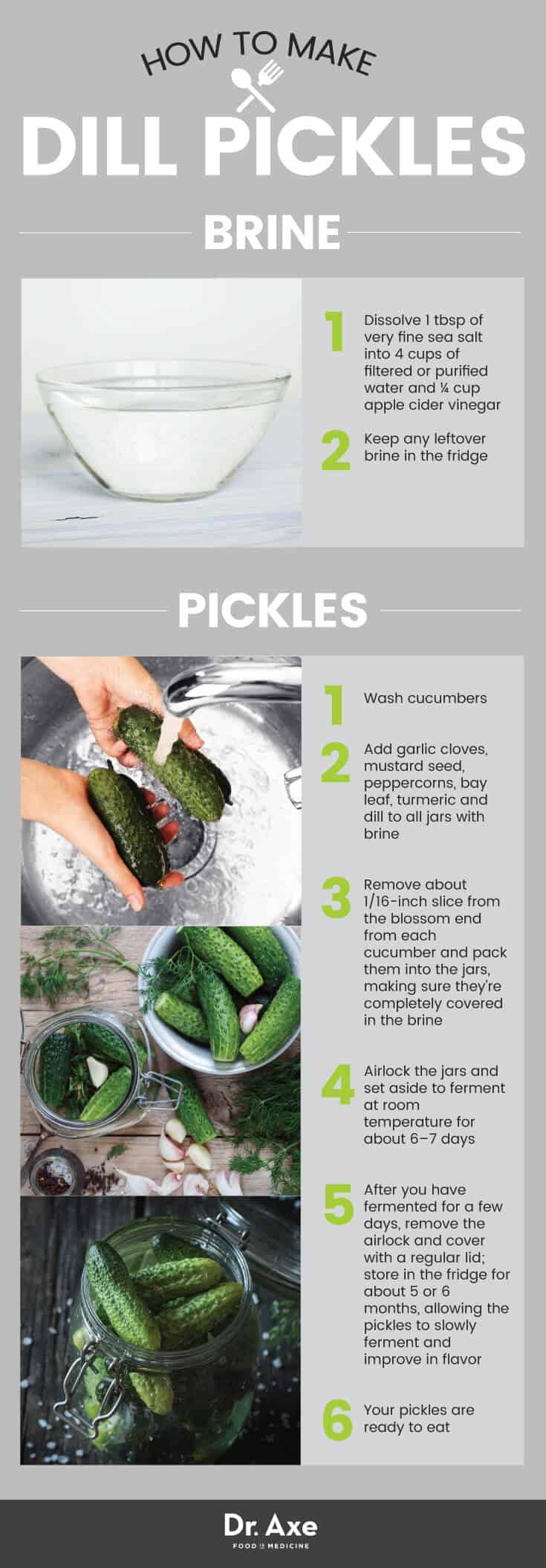
  1. Dissolve 1 tablespoon of very fine sea salt into 4 cups of filtered or purified water and ¼ cup apple cider vinegar with the mother.
  2. Any leftover brine will keep in the fridge for a long time.
How to Make Dill Pickles:
  1. It’s critical that you have clean jars with tight-fitting lids. I prefer airtight jars.
  2. Let’s start by making sure your cucumbers are thoroughly washed. Though you can slice the cucumbers in numerous ways from thick to thin to length-wise, in this recipe we keep the cucumber whole.
  3. Now, add the garlic cloves, mustard seed, peppercorns, bay leaf, turmeric and dill to all jars with brine.
  4. Next, remove about 1/16-inch slice from the blossom end from each cucumber and pack them into the jars, making sure they’re completely covered in the brine. (Note: The blossom end is opposite the stem end. According to the National Center for Home Food Preservation, this is important because blossoms may contain an enzyme that causes excessive softening of pickles.) (3)
  5. You will likely need to add a weight to the top of the pickles to keep them from floating to the top, such as a glass weight. Just make sure that whatever you use, it’s clean.
  6. Next airlock the jars and set aside to ferment at room temperature for about 6–7 days. Warmer environments speed up the fermenting process.
  7. After you have fermented for a few days, remove the airlock and cover with a regular lid. Store in the fridge for about 5 or 6 months, allowing the pickles to slowly ferment and improve in flavor. However, you can start enjoying them any time. Note: The brine may appear cloudy as time progresses. This is normal. You may see fizz. This is simply part of the fermentation process and is also normal. Make sure to avoid too much brine as it can cause some leaking and be messy. However, if you see this, it’s OK. If you notice a pungent smell, it’s possible that bad bacteria has caused it. I would suggest getting rid of them and trying again.
  8. To keep your pickles crunchy, buy the freshest and most firm pickling cucumbers. You can keep them in ice water for a couple of hours to help them stay firm, but I suggest canning right away for best results. You can add a ¼ teaspoon loose black tea leaves to add tannins, which may help keep them crunchy.

Benefits of Dill Pickles

1. High in Fiber
The Journal of the American Medical Association recognizes that much disease is directly related to the bulk and consistency of stools, which has a lot to do with fiber intake. The typical diet is low in fiber, which could explain, in part, why so many health problems exist today, including “heart disease, appendicitis, diverticular disease, gallbladder disease, varicose veins, deep vein thrombosis, hiatus hernia, and tumors of the large bowel.” (4)
Since the dill pickle contains fiber, it makes for a great option to add to a high-fiber diet.
2. Help Fight Cellular Damage
Most vegetables contain antioxidants, and the dill pickle is no different, even though the amounts are smaller than a colorful carrot. Regardless, dill pickles do contain the benefits of antioxidants, which are important in helping fight off those free radicals that can cause cellular damage.
Dill contains monoterpene effects, which ultimately help antioxidant molecules attach to oxidized molecules that would otherwise do damage in the body. These effects were confirmed in a multinational study, and research showed that the antioxidant activity of dill is comparable to ascorbic acid, alpha-tocopherol and quercetin. Thus, dill exhibits anti-inflammatory and analgesic properties that fight free radical damage. (5)
Overall, the daily use of dill, in various forms, common in India due to the antioxidant activity of extracts that are superior to known antioxidant ascorbic acid, makes it a great addition to food.

How to make dill pickles - Dr. Axe

3. May Treat Leaky Gut
Much like fermented sauerkraut, pickles may contain gut-beneficial probiotics. In fact, one German study notes that “Hippocrates described sauerkraut as a health food and medicinal remedy in his writing,” making the pickle a cousin to this benefit. (6)
Probiotics aid in digestion, and when your body properly digests foods, that can greatly assist in weight loss and overall proper function. Pickles are a fermented food that contain gut-friendly bacteria to help with that good digestion and even encourage improvements in leaky gut. (7)  
4. Reduce Muscle Cramps
A study conducted by the Department of Health, Nutrition, and Exercise Sciences at North Dakota State University revealed that the ingestion of pickle juice may help reduce, and even eliminate, muscles cramps and spasms. Participants in the study were induced with muscle cramps, and researchers concluded that “pickle juice, and not deionized water, inhibits electrically induced muscle cramps in hypohydrated humans.” (8)
Research indicates that it may be the vinegar, the salt or the magnesium it contains, or perhaps a combination. Regardless, consuming dill pickle juice at the first sign of cramps or if you’re prone to cramping may be a game changer for even the strongest athlete. 

Another study out of Brigham Young University shows that exercise-associated muscle cramps were eliminated within 35 seconds of consuming pickle juice. However, it’s important to note that while consuming additional salt may be useful for cramping due to the large amounts of sodium that can be lost during athletic performances through sweat, salt can also dehydrate the body. Being knowledgeable of proper intake amounts should be part of any training and race plan. (9)
Turns out, pickle juice may work for menstrual cramps as well. A study conducted by the Department of Biostatistics and Demography at Khon Kaen University in Thailand looked at dill’s effects among students with primary dysmenorrhoea, also known as painful periods or menstrual cramps, that were in their late teens or early 20s. Interventions included 12 different herbal medicines: dill, chamomile, cinnamon, rose, fennel, fenugreek, ginger, guava, rhubarb, uzara, valerian and zataria, as well as five non-herbal supplements in a variety of formulations and doses. While the effects were not strong, some evidence of effectiveness for several supplements was clear in that they reduced some of the discomfort and pain associated with cramps, including dill. (10)
5. May Reduce Blood Clotting
Vitamin K is mostly known for helping prevent blood clotting and strengthening bones. It does even more, such as enhancing brain function, promoting a healthy metabolism and potentially fighting cancer.
The University of Maryland explains that vitamin K is a fat-soluble vitamin, which means the body stores it in fat tissue and the liver. Though it’s uncommon to be low in vitamin K, the university reports that taking antibiotics can destroy good bacteria, possibly leading to a mild deficiency. Having a pickle or two can help ensure that vitamin K stays at healthy levels in the body since one cup of chopped dill pickles contains about 55.8 micrograms or about 70 percent of the recommended daily allowance. (11)

Dill Pickle Nutrition

A cup of chopped or diced dill pickles (143 grams) contains about: (11)
  • 17.2 calories
  • 3.7 grams carbohydrates
  • 0.9 gram protein
  • 0.2 gram fat
  • 1.6 grams fiber
  • 55.8 microgram vitamin K (70 percent DV)
  • 1,251 milligrams sodium (52 percent DV)
  • 60.1 milligrams calcium (6 percent DV)
  • 262 IU vitamin A (5 percent DV)
  • 132 milligrams potassium (4 percent DV)

Precautions with How to Make Dill Pickles

As noted above, the biggest concern I have about dill pickles is the amount of salt they contain. That’s why making your own is the way to go so you can control your salt intake. Consider using my recipe on how to make dill pickles, and make sure to monitor salt intake as needed, regardless of age and activity level.
When preparing any fermented foods at home, it ‘ important to make sure everything is clean to start. Pickled and fermented products are subject to spoilage and should be handled with care.

Final Thoughts on How to Make Dill Pickles

Pickles can be a great way to spice up some of your favorite recipes. I love that they can replace high-fat and high-calorie condiments without leaving you feeling deprived. Plus, dill pickles contain fiber, antioxidant, vitamin K and more, which can help with cramps, leaky gut, blood clotting and more.
So, in order to enjoy the benefits of dill pickles, follow my recipe for how to make dill pickles that are both healthy and delicious.

Read Next: 8 Surprising Dill Weed Benefits (#6 Is Energizing)